

Why Attackers Target School Districts
Pt 2: Soft Targets, High Leverage

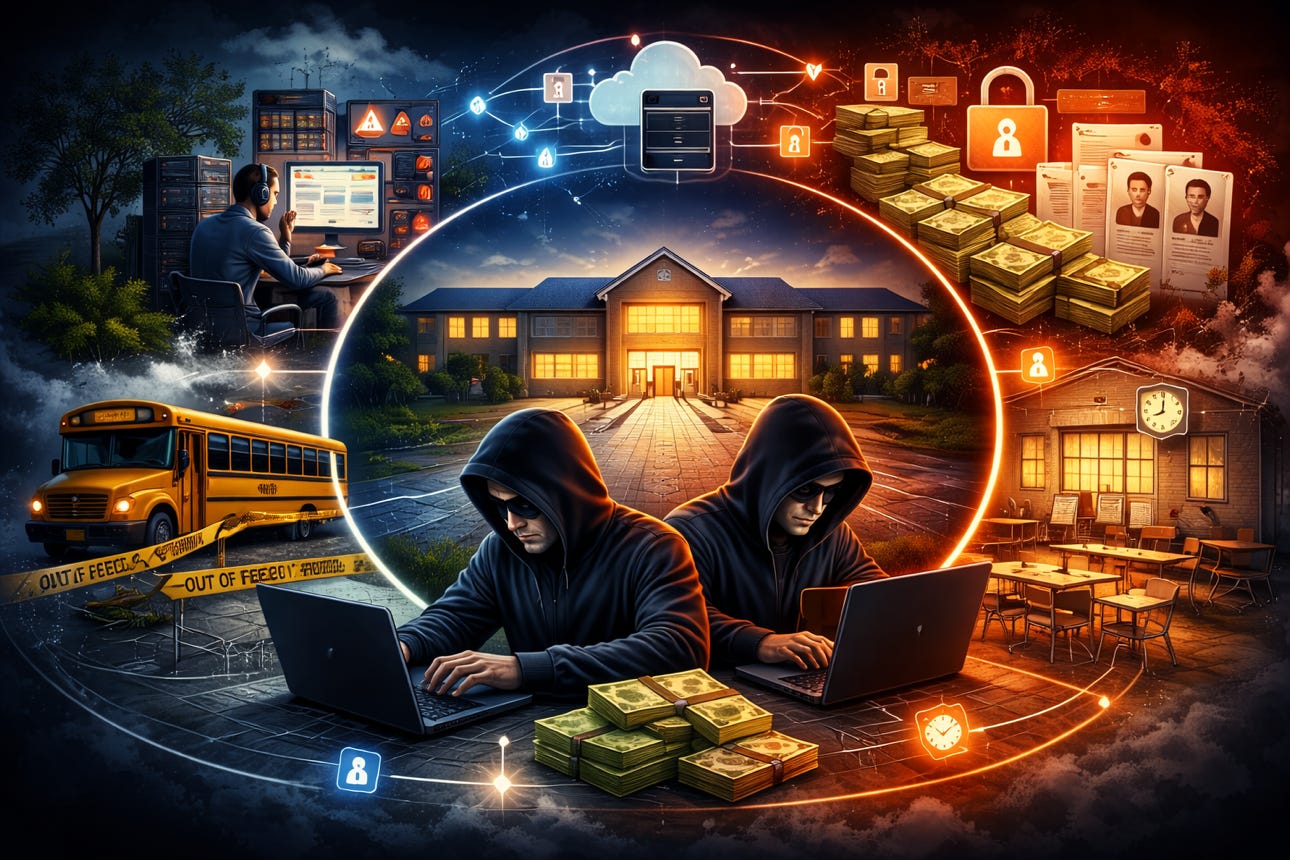
When district leaders ask “Why would someone attack a school?” they’re usually imagining a motive that doesn’t fit their reality: political extremism, ideological hostility, or some kind of targeted vendetta. Most often, they picture the stereotypical hacker in a black hoodie.
But in reality, that’s almost never what’s happening.
K12 school districts are targeted for a much simpler reason. They sit at the intersection of weak defenses, valuable data, and intense pressure to restore operations quickly. To cybercriminals, that combination looks less like a school system and more like a predictable business opportunity.
Understanding why attackers choose K12, and not just how they get in, is essential for making good leadership decisions. Motivation shapes tactics. And tactics determine which defenses actually matter.
The “soft target” equation in K12
Cybercriminals don’t need to defeat the strongest organization. They need to find the easiest one that still pays.
For many attackers, K12 districts meet that bar consistently because of four structural characteristics.
1. Limited cybersecurity resources
Most school districts were never built to operate like hardened enterprises. IT teams are often small, budgets are tightly constrained, and cybersecurity competes with urgent instructional and operational needs.
In many districts, one IT director wears multiple hats (networking, devices, SIS support, help desk, security, etc., etc.). Frequently, this director also comes from a non-technical instruction background (like myself, a tenured middle school English teacher). Additionally, there is rarely a dedicated security analyst or incident responder on staff. Finally, in the instructional setting, investments in prevention are easier to defer than investments in classrooms, buses, or staffing.
Attackers understand this reality. They don’t assume districts are careless; they assume districts are overextended. That assumption is often correct.
2. Large digital footprints with uneven controls
Modern K12 districts rely on a multitude of systems:
Cloud-based student information systems
Dozens, if not hundreds, of edtech platforms
Remote access for staff
1:1 student devices
Vendor integrations moving data behind the scenes
Each of these expands the attack surface. But controls, like multi-factor authentication, vendor security reviews, or consistent patching, are often applied unevenly.
From an attacker’s perspective, that means more chances to find entry points like reused passwords or phishing prone accounts. Exposed management interfaces, open ports like RDP or SSH, or other remote access points like VPNs are also common. To make matters even more painful for districts, the open door can come from a vendor who has weaker defenses that the district itself.
3. High-impact disruption potential
Schools don’t just use technology. They depend on it.
When systems go down, districts can’t simply delay work because instruction stops or is degraded. Core functions like attendance and payroll are immediately impacted, along with key services like transportation and food services. To round out the situation, in the face of a time-critical crisis, communication both internally and with families and the community can become exponentially harder depending on the impacted systems.
Attackers exploit this dependency. The faster an organization needs to be back online, the more leverage an attacker has, especially in ransomware and extortion scenarios.
4. No mandatory, enforceable cybersecurity baseline
Unlike some regulated sectors, K12 has historically lacked three key areas:
Required cybersecurity standards
Consistent state-level enforcement
Funding tied directly to security maturity
Compliance requirements like FERPA and CIPA focus on privacy and content filtering and not technical resilience against cybercrime. Attackers benefit from this inconsistency. Districts vary widely in preparedness, and there’s no universal floor they must clear.
Why K12 data is valuable, even without “secrets”
A common misconception is that schools aren’t interesting because they don’t hold trade secrets or classified research.
That misunderstands how cybercrime economics works.
Student and staff data is monetizable
K12 systems often contain Personally Identifiable Information (PII) like:
Social Security numbers
Birthdates
Addresses and family information
Health and special education records
Employment and payroll data
For criminals, this data can be sold in bulk, used for tax fraud or credit fraud, or used in long-term identity theft, especially for minors
Children’s identities are particularly valuable because misuse may go unnoticed for years. A stolen student identity can quietly accumulate damage long before anyone checks a credit report.
Psychological leverage matters
Beyond resale value, K12 data has emotional weight.
Attackers know that parents react strongly to threats involving children and that district leaders face intense public scrutiny. This can make media attention escalate quickly when schools are involved
In several past incidents, attackers have even used stolen school data to harass families or threaten communities. Even when threats are not credible, the fear and disruption they create increase pressure on districts to resolve incidents quickly.
A January 2026 ransomware incident at a Belgian secondary school illustrates how attackers increasingly weaponize fear and family trust, not just system downtime. After the school refused to pay a ransom following an incident, attackers escalated by contacting students’ families directly. Parents received threatening emails demanding a small payment per child (about $60 USD), accompanied by warnings that private information like home addresses or photos could be released if the ransom was not paid.
While the amount demanded was relatively modest, the tactic dramatically increased psychological pressure. Instead of negotiating with a single institution, attackers shifted the burden onto hundreds of families, amplifying fear, uncertainty, and reputational risk for school leadership. Even with classes continuing and law enforcement involved, the incident became a community crisis rather than a technical one.
This pattern highlights a critical reality for district leaders: cyberattacks on schools are increasingly designed to exploit emotional leverage, particularly parental concern for children, when technical extortion alone fails. The goal is not just system access, but accelerated decision-making under public pressure.
Timing attacks for maximum pressure
Cyberattacks on school districts are rarely random in timing. Criminal groups frequently launch attacks at critical moments on the school calendar. Key times include the start of the school year, but attacks also increase during holidays or long weekends. Most impactful, school testing calendars are also exploited.
Strikingly, these moments all share two traits: high operational dependence and reduced staffing. From the attacker’s view, this increases the pressure of downtime, confusion, and the likelihood of rushed decisions.
Understanding this pattern helps leaders anticipate risk windows and plan training, staffing, monitoring, and communication accordingly.
How attacker motivation differs from higher education
Another source of confusion is assuming that K12 and higher education face the same motivations.
They don’t.
Most K12 incidents are driven by ransomware extortion, fraud and payment diversion, and data theft for resale.
There is little evidence of sustained nation-state interest in K12 districts. School boards and SIS databases are not espionage targets.
Higher education: broader motivations
Universities face many of the same criminal threats, but have the added pressures of nation-state espionage, intellectual property theft, and politically motivated hacktivism
This distinction matters because defenses should align with threat models. K12 does not need to plan primarily for advanced espionage, but it does need to be very good at blocking common criminal pathways. Often, schools feel pressure to defend themselves against advanced threats by allocating budget to enterprise-grade tooling, when they may be lacking in basic cyber hygiene.
The role of perceived “ease”
Cybercriminals talk. Tactics spread. Targeting patterns follow success.
Once a ransomware group finds that districts are underprepared by things like lacking MFA or having inconsistent backups, schools begin to look like repeatable opportunities rather than one-off targets. Add to this perfect storm the fact that schools often have slow incident response, and that most schools carry some level of cyber insurance, and K12 is a very appealing target.
This doesn’t mean districts are reckless. It means attackers optimize for return on effort.
What this means for district leaders
The most important leadership takeaway is this:
K12 districts are targeted not because they are schools, but because they are predictable under pressure.
That has implications for governance, not just technology.
Leaders influence risk by:
Setting expectations for security fundamentals (like MFA and backups)
Treating vendor selection as a risk decision, not just an instructional one
Supporting realistic incident planning and exercises like tabletop exercises
Aligning budgets with risk rather than fear or headlines
Cybersecurity posture is shaped as much by leadership priorities as by tools. Districts can’t eliminate all risk. But they can reduce attacker leverage. That means focusing on controls that:
Make entry harder (phishing resistance, MFA)
Limit spread (network segmentation, least privilege)
Reduce panic (tested backups, continuity plans)
Speed recovery (clear roles, practiced response)
When attackers believe disruption won’t force fast payment or chaos, they often move on.
Leadership questions:
To translate motivation into action, district leaders can ask:
What systems create the most pressure if they go down? Are those the most protected?
Which decisions would feel “rushed” during an incident? How can we pre-decide them?
Are we reducing attacker leverage, or just adding tools?
Do our vendors increase or decrease our overall risk profile?
Have we planned for disruption as an operational reality, not an IT failure?
These questions don’t require technical depth, but they do require ownership.